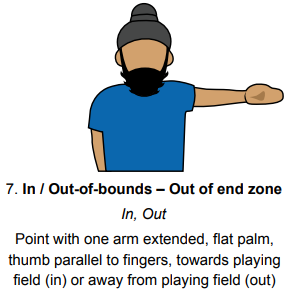
11.1. The entire playing field is in-bounds.
The perimeter lines are not part of the playing field and are out-of-bounds.
All non-players are part of the out-of-bounds area.
11.2. The out-of-bounds area consists of the ground which is not in-bounds and everything in contact with it, except for defensive players, who are always considered “in-bounds”.
11.3. An offensive player who is not out-of-bounds is in-bounds.
11.4. The following are out-of-bounds turnovers, and no catch is deemed to have occurred:
11.5. A disc is in-bounds once play is live, or when play starts or restarts.
11.6. A disc becomes out-of-bounds when it first contacts the out-of-bounds area or contacts an out-of-bounds offensive player. A disc that has been caught by an offensive player has the same in/out-of-bounds status as that player. If the disc is simultaneously caught by more than one offensive player, one of them being out-of-bounds, the disc is out-of-bounds.
11.7. The disc may fly outside a perimeter line and return to the playing field, and players may go out-of-bounds to make a play on the disc.
11.8. The place where a disc went out-of-bounds is the location where, prior to contacting an out-of-bounds area or player, the disc was most recently
11.9. If the disc is out-of-bounds and more than three (3) metres from the pivot location, non-players may retrieve the disc. The thrower must carry the disc the last three (3) metres to the playing field.